Uplifted animals
5 SFF Books About Uplifted Animals
By Ilana Marsh May 16, 2026 8 min read
Uplift is the deliberate genetic or technological elevation of an animal species to intelligence comparable to, or exceeding, a human being’s. The term comes from science fiction, but the underlying question is old: what do humans owe a mind they helped create? These five books treat uplift as a structural fact of their worlds, tracing consequences for consent, labor, kinship and rights across a century of speculative writing about who gets to think.
The Island of Doctor Moreau by H.G. Wells (1896)
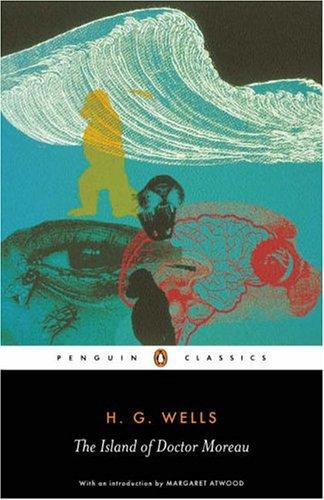
Shipwreck survivor Edward Prendick washes up on a remote Pacific island run by the exiled vivisectionist Doctor Moreau, who has spent years surgically and psychologically reshaping animals into humanlike beings he calls the Beast Folk. Moreau forces his creations to recite the Law, a chanted code against reverting to animal violence, while Prendick slowly realizes how thin the line between the island’s “humanized” animals and its human inhabitants really is. When one of Moreau’s creations kills him, the Law collapses and the Beast Folk begin sliding back toward their original natures.
Moreau’s project is uplift attempted through the crudest available tools of its era: the scalpel, the branding iron and psychological conditioning rather than genetics. Wells is explicit that Moreau’s goal is not simply to disguise animals as people but to “burn out all the animal” and instill reason, speech and a moral sense, which makes the island a controlled experiment in whether intelligence and civility can be forced onto a creature that never consented to receive them. The novel treats the experiment as a failure of both method and ethics, since the Beast Folk’s veneer of humanity depends entirely on Moreau’s continued domination and terror.
Wells trained as a biology teacher under Thomas Henry Huxley, the naturalist known as “Darwin’s Bulldog,” and wrote the novel not long after Huxley’s influential lecture “Evolution and Ethics,” which argued that civilization requires constant struggle against humanity’s animal inheritance. Wells later called the book “an exercise in youthful blasphemy” written to explore what remains of a person once cruelty and pain are stripped of any redemptive purpose, a preface note attached to a 1930s reissue of the novel.
Sirius by Olaf Stapledon (1944)
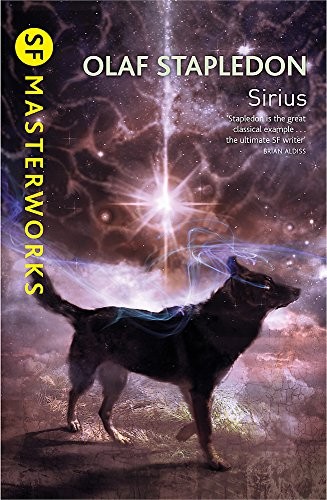
Scientist Thomas Trelone uses hormone treatments to raise a sheepdog’s cognition to human levels, producing Sirius, who is reared alongside Trelone’s daughter Plaxy as something between a sibling and an experiment. Sirius grows into a mind capable of philosophy, music and love, but he remains housed in a body built for herding sheep, unable to hold a pen or be legally recognized as a person by the society around him. His attachment to Plaxy deepens into a romantic bond that neither the family nor the wider world can accommodate.
Stapledon isolates uplift down to a single case rather than a whole species, which lets him dwell on the practical and emotional gap between a humanlike mind and a nonhuman body. Sirius can quote scripture and compose choral music, yet he still feels the pull to chase sheep, and the novel treats that tension, rather than any external villain, as its central conflict. His story ends in exile and death at a farmer’s gun after his instincts and his intellect can no longer be reconciled inside one animal.
Stapledon wrote the novel while living in rural Wales among sheepdogs, and critics have long read Sirius’s divided nature as an extension of his 1930 philosophical work Star Maker, which treated evolutionary process itself as a subject worthy of sustained ethical attention. I did not find a direct interview or essay in which Stapledon discusses his motivation for Sirius specifically, so that reasoning is not attributed to him here; what is documented is his formal training in philosophy at Liverpool and Oxford, which shaped his fiction’s recurring interest in minds built by forces indifferent to the individual who results.
Norstrilia by Cordwainer Smith (1975)
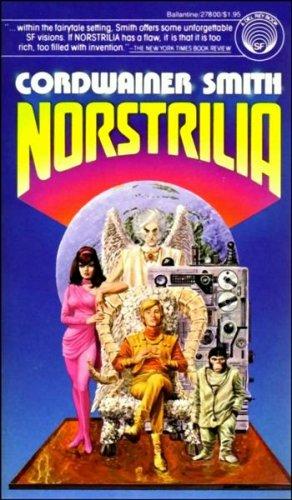
Rod McBan, a sheep rancher from the isolated planet Norstrilia, becomes briefly the richest person in the galaxy through a market speculation and is sent to Earth to escape the political danger his wealth creates. There he is guided through Earth’s underclass by C’mell, a cat-derived woman, and meets the underpeople, laborers made from uplifted animals who live under strict legal subordination to true-born humans. Rod’s fortune becomes leverage in the underpeople’s long campaign for basic rights, administered through the shadowy human bureaucracy called the Instrumentality of Mankind.
Smith folds uplift into an entire caste system rather than a single laboratory case, giving each underperson a species origin, such as cat, dog or bear, that still marks their legal status centuries after their ancestors were re-engineered into humanlike form. The underpeople can think, love and organize politically, but the Instrumentality withholds full personhood from them by law, so their intelligence functions less as a technical achievement than as an unresolved civil rights claim running under the entire Instrumentality of Mankind sequence. Rod’s decision to spend his wealth on their cause is what turns the book’s political background into its plot.
Cordwainer Smith was the pen name of Paul Linebarger, a scholar of Asian politics and psychological warfare who advised the U.S. government on propaganda; biographers and critics have connected the underpeople’s second-class status to his professional exposure to colonial and wartime hierarchies of who counts as fully human. I did not find a direct statement from Linebarger explaining the underpeople as a deliberate allegory, so that link is presented as critical interpretation rather than his own stated intention, drawn from the biographical account in the Instrumentality of Mankind reference history.
Startide Rising by David Brin (1983)
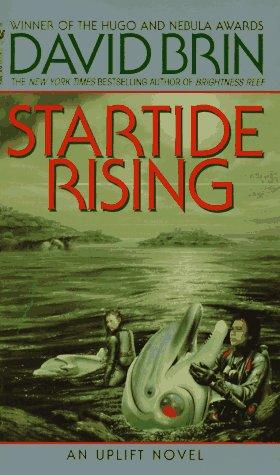
The exploration ship Streaker, crewed mostly by uplifted dolphins alongside a handful of humans and one uplifted chimpanzee, finds an immense derelict fleet that may belong to the Progenitors, the mythic first species said to have started the galaxy’s chain of uplift. Word of the discovery draws a crowd of rival alien factions to the ocean world Kithrup, forcing Streaker’s crew to hide, repair their battered ship and survive shipboard political fractures of their own. The crew’s dolphins speak in three linguistic registers, from workaday Anglic to a poetic dolphin language called Trinary, reflecting minds that are humanlike without being human.
Brin builds an entire galactic civilization on the premise that older “patron” species uplift younger “client” species into sentience and then hold them in a debt of service that can run for a hundred thousand years. Earth is treated as an anomaly because humans uplifted dolphins and chimpanzees into near-equal partners rather than indentured clients, and the novel uses the Streaker crew’s mixed-species command structure to dramatize what that unusual choice costs and enables under pressure. Brin popularized “uplift” as science fiction’s standard term for the practice through this Hugo and Nebula Award-winning novel and the wider series it belongs to.
Brin has written directly about the real-world case for the idea, arguing that raising the intelligence of species such as dolphins and chimpanzees would give humanity “others to talk to,” while acknowledging that any real attempt would draw fierce and partly justified opposition from animal rights advocates. He has continued to defend uplift as a serious long-term biological and ethical question on his own blog, treating it as a live possibility rather than a purely literary device.
Dogs of War by Adrian Tchaikovsky (2017)
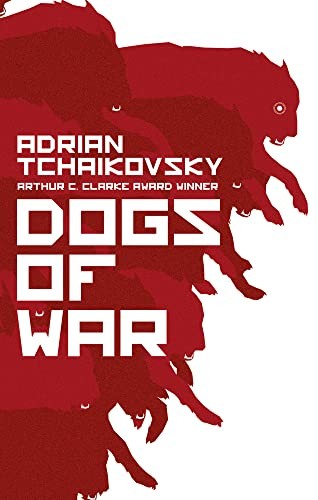
Rex is a genetically engineered dog-human hybrid soldier, a “bioform” built for close combat and bound by an obedience-enforcing collar, who fights alongside an uplifted bear, a camouflaging reptile and a swarm of networked bio-engineered bees in a private military unit in war-torn Mexico. When their commander is charged with war crimes after the unit is blamed for civilian deaths, Rex and his squad lose their chain of command and must work out, largely for the first time, what they actually want. The back half of the novel follows Rex into a courtroom fight over whether bioforms like him are property or persons.
Tchaikovsky ties uplift directly to consent and control rather than treating intelligence as a gift: Rex’s biofeedback collar can flood him with pain or euphoria to enforce loyalty, so his path toward higher reasoning runs through learning to make choices that were engineered out of him from the start. The novel’s courtroom sections turn the definition of legal personhood into the explicit stakes of the plot, extending the question raised by earlier uplift fiction into a specifically military and legal register.
Tchaikovsky has described the bioforms as deliberately blurring “the line between animals and people,” and has pointed to recent research on jumping spiders and crabs as evidence that real animal cognition is more layered than older behaviorist models allowed. He has said Rex’s arc turns on learning “what does he want to be loyal to based on his own informed choice,” framing consent, not obedience, as the mark of the intelligence Rex was built to have.
Explore Related Ideas
- 5 SFF Books About Space Elevators
- 5 SFF Books About Terraforming
- 5 SFF Books About Generation Ships
- 5 SFF Books About Post-Scarcity Societies
- 5 SFF Books About Sentient Trees
- 5 SFF Books About Mind Uploading as Death
- 5 SFF Books About First Contact as Colonial Encounter
- 5 SFF Books About Time Loops in Which Only One Person Remembers