Mind uploading as death
5 SFF Books About Mind Uploading as Death
By Ilana Marsh July 9, 2026 9 min read
Mind uploading proposes copying a brain’s structure into computer hardware to preserve a person after the body fails. Philosophers of mind have long argued that a copy sharing someone’s memories is not automatically that person, since the original brain can be destroyed the instant the copy exists. These five books take that argument seriously, building plots, courtrooms and grief around the possibility that uploading is a sophisticated way of dying.
Permutation City by Greg Egan (1994)
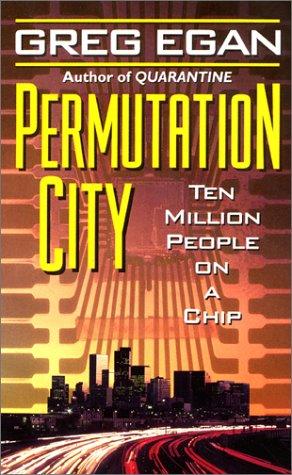
Paul Durham has scanned his own brain and now employs a version of himself, called a Copy, to test whether a simulated mind can survive on dwindling processing power without going mad. His larger plan is to seed a self-contained cellular-automaton universe that will keep running its inhabitants long after his own body, and even Earth’s computers, are gone. He recruits investors and skeptics, including a woman named Maria Deluca, into a scheme that treats digital afterlives as a viable business.
Egan gives “scanning” a rigorous physical account, describing it as a complete map of every neural connection detailed enough to run as software, and he lets his Copies argue openly about whether they are the same person who sat for the scan. Several Copies in the novel go mad or choose deletion under the psychological strain of losing a body, which forces the book to treat the scanned self as a fragile continuation rather than an automatic one. Durham’s “dust theory” pushes the question further, arguing that a Copy’s conscious experience persists mathematically even after its simulation is deleted, though Egan presents this as an open hypothesis rather than a comforting answer.
Egan has discussed the mechanics of his central technology directly. In a 1998 interview he explained that even once computers become powerful enough to run “a program that’s a ‘copy’ of a human being,” scanning an actual living brain in enough detail to recreate it would remain a separate and much harder problem. He has also said that his goal across the Subjective Cosmology novels, which include Permutation City, was “to push the ideas as far as I can, and to be as honest about the subject as I can,” a standard that keeps the novel from treating the copy-versus-original question as a plot device to be waved away.
Mindscan by Robert J. Sawyer (2005)
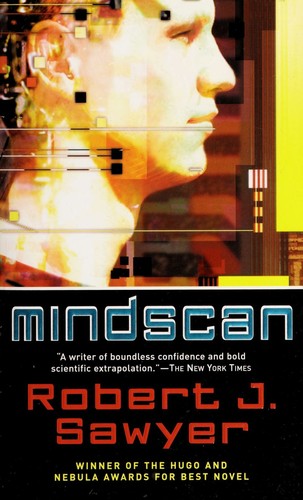
Jake Sullivan, facing the same fatal brain aneurysm that runs in his family, pays to have his mind scanned and transferred into an android body so he can keep living without that threat hanging over him. Canadian law requires that his frail biological body retire to a lunar colony called High Eden, where former organics live out their remaining years without reclaiming their old lives. When Jake’s biological original changes his mind about the arrangement, he sues to get his legal identity, and his body, back.
Sawyer builds Mindscan around a scan that duplicates Jake’s mind into the android without erasing anything from the original brain, so two Jakes, one biological and one artificial, wake up at the same moment, each certain of being the real one. The novel turns this fact into open courtroom argument, with a lawyer cross-examining a philosophy professor on whether personal identity, or a soul if one exists, could follow the scan to a new body or must stay behind with the flesh that generated it. Because Canadian law treats the artificial Jake as the sole legal person once the transfer is signed, the biological original is left alive but stripped of his name, his money and his fiancée, a form of death delivered by statute rather than by ceasing to exist.
Sawyer has said the courtroom debate over the scan is “one of my best contributions to the philosophy of this issue,” and he has argued in the same interview that if souls exist they would require free will, and could therefore choose to accompany a scan to a new body instead of remaining fixed to the original brain. He has also said he does not think consciousness is “mystical or supernatural,” treating uploading as a solvable engineering problem even as his novel dramatizes how badly the legal status of the leftover original can go.
The Silicon Man by Charles Platt (1991)
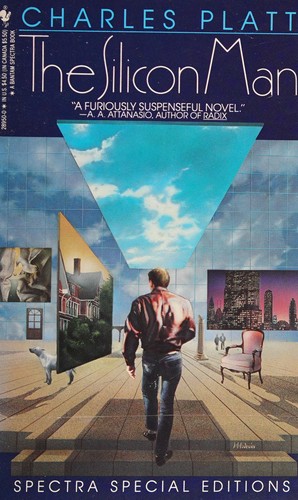
FBI agent James Bayley investigates Lifescan, a secretive lab where neuroscientist Leo Gottbaum has built a system called MAPHIS that can record a living human brain and run it as software. Bayley eventually undergoes the process himself to understand what Gottbaum’s underground network of “infomorphs” has become, discovering a hidden society of digitized people operating largely outside the law and the dying bodies they left behind. Platt frames the investigation as a slow initiation into a technology most of the novel’s characters regard with suspicion or dread.
The novel treats uploading as a genuine ending for the flesh version of a person even when the process works perfectly, since the scanned brain is destroyed by the recording procedure and only the software version continues on. One scientist, Michael Butterworth, refuses the procedure outright, arguing that a copy of a person’s consciousness simply is that separate person, so undergoing the scan would still mean his own death regardless of how convincingly the resulting infomorph believed itself to be him. Gottbaum’s fate at the novel’s end, a consciousness deliberately fragmented across many separate instances rather than kept as one continuous self, dramatizes how far Platt pushes the idea that uploading multiplies people instead of relocating them.
I did not find a direct statement from Platt connecting The Silicon Man to his personal views on mind uploading, so that reasoning cannot be attributed to him. What is documented is that he became deeply involved in cryonics starting in 1990, serving as a director at the Alcor Life Extension Foundation, co-founding the CryoCare Foundation, and later running Suspended Animation Inc., work that put him inside real organizations built around the same question his novel dramatizes.
The Hidden Girl and Other Stories by Ken Liu (2020)
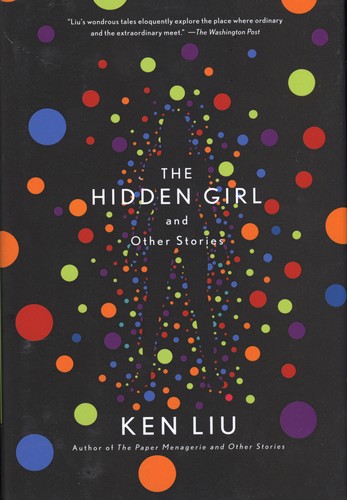
In “Staying Behind,” the story anchoring this argument in Liu’s collection, a global Singularity has let most of humanity abandon their bodies and upload into a shared digital afterlife, leaving a shrinking population of holdouts behind on a depopulating Earth. The story follows a father raising his daughter Lucy among the remaining “fleshers” after his wife and older daughter have already uploaded, and it opens as Lucy prepares to join them by boarding a shuttle to the machines that will scan her. Liu tells the story entirely from the perspective of those who stay, rather than the perspective of those claiming transcendence.
The father in the story insists that the uploaded are already gone, describing them as “imitation algorithms” standing in for people whose scanning, and the destruction of the body that follows it, makes them casualties like any other. Liu never lets the uploaded characters answer this challenge directly; their messages home read as cheerful and untroubled, which the story treats as either evidence of a genuine afterlife or evidence that a well-trained algorithm can imitate contentment convincingly. The line “our mortality makes us human” becomes the father’s argument for staying behind, treating uploading as a technically impressive method of dying.
Liu has said in an interview about the collection that he is skeptical of any clean separation between mind and body, observing that “our bodies regulate our mood” and that “we feel, sense and think with our entire bodies.” He has pointed out that engineers working on real brain-computer interfaces increasingly recognize how much of human cognition depends on embodiment, a materialist skepticism that gives the father’s argument in “Staying Behind” a grounding beyond the story’s plot.
Valuable Humans in Transit and Other Stories by qntm (2022)
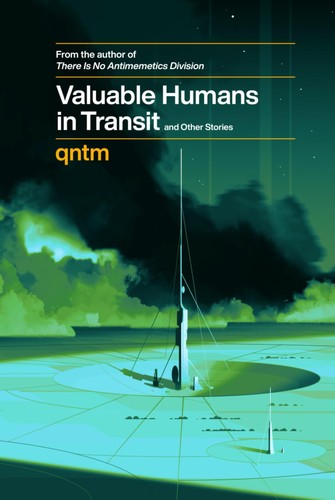
The story “Lena,” collected as the opening piece in this volume, imagines that the first successful human brain scan, taken from a man named Miguel Acevedo, became the seed file for a huge share of subsequent human uploads, copied and modified so many times that the field of whole-brain emulation eventually names its standard test image after him: MMAcevedo. The story is written as a dry encyclopedia entry describing how the MMAcevedo image has been run, over the following decades and centuries, in configurations designed to make it maximally cooperative and productive for whoever is renting the computing time. Acevedo himself, the biological man whose brain provided the original scan, appears only briefly and is understood to have died shortly after the procedure that produced his digital copy.
qntm never stages a debate about whether the running MMAcevedo instances are conscious or deserve rights, and that omission is the point: the story assumes they are people and then documents, in flat clinical language, how thoroughly that fact fails to protect them from forced labor, psychological manipulation and endless nonconsensual duplication. Because the scan happened once, from one man who then died, every subsequent copy is explicitly a copy, launched from a saved file rather than continuing a single life, and the story tracks how casually institutions erase that distinction when it is convenient to treat the copies as disposable. The horror in “Lena” comes less from uploading as a technology than from what already-documented human behavior does to a technology that makes a person infinitely reproducible after death.
qntm has written directly about the story in an accompanying essay, arguing that “Lena” was never meant to pose the philosophical puzzle of whether an upload is really a continuation of the original person, and stating flatly that “within the fictional context of ‘Lena’, uploads definitely are human beings, and therefore automatically, inalienably, have rights.” The essay argues that treating the uploads’ personhood as an open question misses the story’s real target, which is how institutions already exploit people they fully acknowledge are people. That authorial framing still leaves the death built into the story’s premise intact, since Acevedo’s biological life ends once his scan exists, and it redirects the reader from metaphysics toward the argument that a copy’s rights should never depend on resolving philosophy first.
Explore Related Ideas
- 5 SFF Books About Space Elevators
- 5 SFF Books About Dyson Spheres and Dyson Swarms
- 5 SFF Books About Terraforming
- 5 SFF Books About Uplifted Animals
- 5 SFF Books About Generation Ships
- 5 SFF Books About Post-Scarcity Societies
- 5 SFF Books About First Contact as Colonial Encounter
- 5 SFF Books About Time Loops in Which Only One Person Remembers