First contact as colonial encounter
5 SFF Books About First Contact as Colonial Encounter
By Ilana Marsh August 2, 2026 8 min read
Colonial encounter names a specific historical pattern: a technologically or militarily superior party arrives among a people it does not understand, then extracts their land, labor, bodies, or biology while dismantling their institutions, often under the language of improvement or salvation. Applied to first contact, the term asks whether an alien meeting mirrors that structure rather than simple invasion or diplomacy. These five books build the asymmetry, extraction, and cultural rupture into their core machinery.
The War of the Worlds by H.G. Wells (1898)
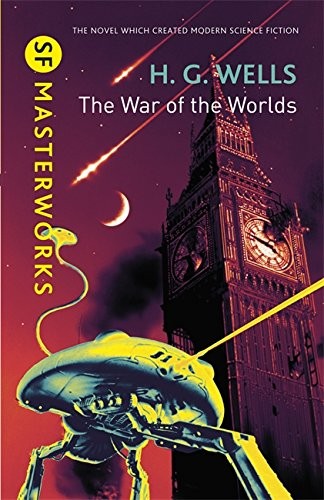
An unnamed narrator watches Martians land in cylinders on the English countryside, then systematically destroy the surrounding towns with heat rays and a black, choking gas, forcing the population into panicked flight toward London. The Martians harvest human blood directly for sustenance and treat the planet as territory to be cleared rather than a civilization to be negotiated with, until Earth’s bacteria kill them before humanity can mount an effective defense. Wells narrates the collapse of Victorian confidence from inside the very empire that had, until then, done the invading elsewhere.
Wells builds the colonial parallel directly into the text rather than leaving it to inference. In the novel’s opening chapter, the narrator compares the Martian assault to the “war of extermination” that European settlers waged against the Tasmanians, asking readers “before we judge of them too harshly” to remember what humanity’s own species had done to others it deemed inferior. The mechanism of the book depends on reversing the imperial gaze: the people who normally read about faraway conquest experience conquest as its object, their cities catalogued and their bodies used as a resource the way ivory or rubber had been.
Wells made this connection to empire explicitly in the novel itself rather than only in later commentary, and critics have consistently read the book as a critique of British imperial practice written at the height of the scramble for Africa. Literary historians tracing the book’s sources have pointed specifically to Wells’s own reference to the Tasmanian genocide as the model the narrator invokes, tying the Martian invasion to a documented episode of colonial extermination rather than a generic threat.
The Word for World Is Forest by Ursula K. Le Guin (1972)
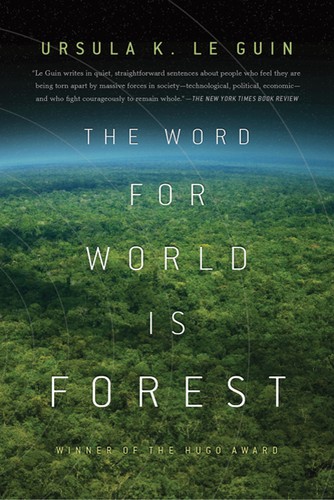
On the forested planet Athshe, human colonists from an overpopulated, deforested Earth log the native woodland for timber and enslave the small, green-furred Athsheans as camp labor, treating them as animals too passive to resist. Captain Don Davidson embodies the occupation at its most brutal, raping and killing with the casual confidence of a man who has never had to answer for it, until the Athshean Selver leads an uprising that teaches his people violence for the first time in their history. Le Guin structures the novel as an ecological and military confrontation between an extractive human colony and a culture organized entirely around dreaming and consensus.
The book stages first contact as a logging operation with a garrison attached, where the aliens are the indigenous population and the humans are the occupying colonial power stripping the planet’s forests to ship home. Its central subject is the disintegration this contact forces on Athshean society, since Selver’s people had no concept of premeditated killing before the humans arrived, and their adoption of organized violence to survive marks a cultural loss the book refuses to treat as a triumph. Le Guin makes the extraction concrete and specific rather than symbolic, tracking board-feet of lumber and the number of Athsheans held as forced labor.
Le Guin wrote the novella in 1968 while living in London and actively organizing against the Vietnam War, and she said directly in her introduction to the 1977 edition that she had “never written a story more easily, fluently, surely” and with less pleasure, because the ethic that permitted defoliation and the killing of noncombatants in the name of peace was, to her, the same ethic that permitted despoiling the Earth for profit. She named the American war directly as the story’s occasion rather than leaving the parallel to critics.
Dawn by Octavia E. Butler (1987)
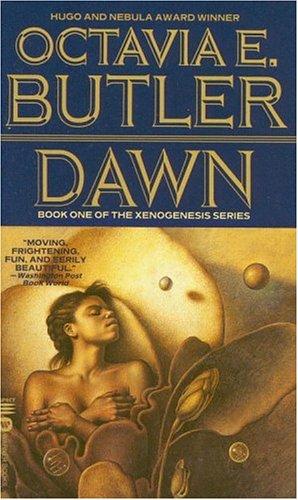
Lilith Iyapo wakes alone in a bare room after nuclear war has ended human civilization, and learns she has been rescued and genetically studied by the Oankali, an alien species that travels between worlds trading its genome with other life. The Oankali offer to revive the remaining human survivors and resettle Earth, but only in exchange for merging permanently with human DNA to produce a hybrid species, and no meaningful refusal is available to Lilith or the humans she is tasked with waking. Butler follows Lilith through the slow, coerced process of accepting a bargain that saves her species while erasing what it means to remain human.
The novel builds a colonial structure around biology itself, making genetic material the resource being extracted rather than land or labor, and consent the mechanism of domination rather than its absence. The Oankali present their intervention as rescue and gift, echoing the paternalist language of historical colonizers who described conquest as civilization, while systematically overriding human autonomy through pheromonal control and reproductive manipulation the humans cannot fully resist or understand. Butler makes the humans’ desperate circumstances themselves the lever that makes submission look like choice, a subtler mechanism than outright force.
Butler discussed Xenogenesis in terms of what she called the human contradiction, the pairing of high intelligence with a hierarchical drive to dominate, which she identified across the trilogy as the trait that dooms humanity to repeat its worst behavior even under alien tutelage. Scholars examining the trilogy’s engagement with settler colonialism have connected this framework directly to the mechanics of dispossession the Oankali enact, reading Lilith’s position as structurally continuous with historical experiences of colonized peoples forced to accept transformation as the price of survival.
The Sparrow by Mary Doria Russell (1996)
When radio telescopes detect music from a planet orbiting Alpha Centauri, the Jesuit order quietly funds and launches its own mission before any government can organize one, sending linguist and priest Emilio Sandoz along with a small team of friends and specialists. The mission makes contact with two related species, the gentle Runa and the dominant Jana’ata who farm them, and Sandoz’s party misreads the planet’s social order badly enough to trigger a massacre. The novel is framed by Sandoz’s traumatized return to Earth as the sole survivor, physically and psychologically destroyed, forced to account for a disaster the Vatican wants explained.
Russell builds the story explicitly on the template of Jesuit missions to the Americas and Asia, where well-intentioned observers with genuine linguistic skill and respect for local custom still triggered catastrophe because they could not see the political structure they were operating inside. The mission’s small footprint and good intentions do not prevent the encounter from ending in violence and exploitation, since Sandoz’s party inadvertently disrupts a food and population system between the two alien species, and the aliens experience the humans as a destabilizing external force regardless of the humans’ own self-image as respectful visitors. The book insists that goodwill does not exempt an encounter from being structurally colonial.
Russell has said the project began around 1992, the 500th anniversary of Columbus’s landing in the Americas, when she wanted to update the experience of explorers, early missionaries, and settlers for a contemporary reader. Trained as a biological anthropologist before turning to fiction, she drew on Jesuit ethnographers such as Matteo Ricci, saying she used his own account of cross-cultural contact directly in shaping Sandoz’s mission.
The Three-Body Problem by Cixin Liu (2008)
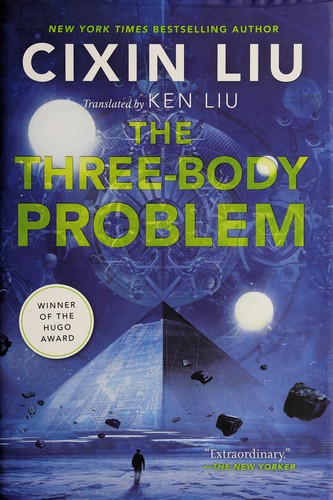
Physicist Ye Wenjie, traumatized by violence she witnessed during the Cultural Revolution, secretly answers a signal from the unstable Trisolaran system and invites its civilization to take Earth, believing humanity incapable of governing itself. Decades later, nanomaterials researcher Wang Miao is drawn into the resulting conspiracy as the Trisolarans, whose planet’s three suns make survival there almost impossible, begin a centuries-long voyage to occupy Earth using near-omniscient particles called sophons to sabotage human science in advance. The novel moves between the Cultural Revolution and the present to explain why Ye chose invasion over rescue.
Liu builds the coming invasion as a slow-motion conquest rather than a single battle, with the Trisolarans exploiting a four-century travel time to dismantle Earth’s capacity for scientific self-defense before a single ship arrives. The sophons function as an instrument of epistemic domination, freezing fundamental physics research worldwide so that humanity cannot out-innovate its way to parity, a strategy that mirrors how technologically advanced colonial powers historically restricted the scientific and industrial development of the territories they controlled. Human collaborators who welcome the invasion, convinced their own species is unworthy of the planet it holds, add a further layer drawn from the psychology of colonized elites who internalize the colonizer’s justification.
Liu has said directly that he drew on China’s own experience of forced encounter with technologically superior foreign powers, recalling “the most tragic memories of modern Chinese history, when China was invaded by other civilizations” that held a decisive technological edge, and that he wanted an alien invasion to carry the same shocking effect on Chinese readers that this history still holds. He has connected this memory explicitly to his choice of an overwhelming, technologically asymmetric alien threat rather than a more balanced contact scenario.
Explore Related Ideas
- 5 SFF Books About Space Elevators
- 5 SFF Books About Terraforming
- 5 SFF Books About Uplifted Animals
- 5 SFF Books About Generation Ships
- 5 SFF Books About Post-Scarcity Societies
- 5 SFF Books About Sentient Trees
- 5 SFF Books About Mind Uploading as Death
- 5 SFF Books About Time Loops in Which Only One Person Remembers