Post-scarcity societies
5 SFF Books About Post-Scarcity Societies
By Ilana Marsh June 15, 2026 8 min read
Post-scarcity describes a society where automation, replication or abundant energy has eliminated material want, so goods and labor no longer determine survival or status. Economists have long debated whether such abundance is achievable, or whether it would simply relocate scarcity into reputation, attention or meaning. These five books take that question seriously, imagining what actually governs a life once material want disappears, from anarchist space opera to reputation economies to communities that never adopted capitalism at all.
The Player of Games by Iain M. Banks (1988)
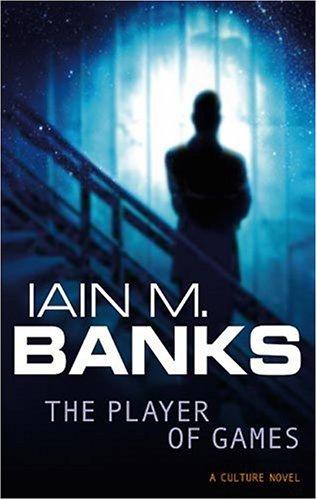
Jernau Morat Gurgeh is the finest game player in the Culture, a vast interstellar civilization where machines handle production and citizens are free to spend their lives on whatever interests them, in his case an obsessive mastery of games. Bored and quietly restless despite having everything he could want, he is maneuvered by a Culture intelligence into traveling to the Empire of Azad, a hierarchical, scarcity-driven civilization that determines political rank through a single immense game. Gurgeh’s competition in that tournament becomes a collision between two entirely different ways of organizing a society around what people lack or already have.
The Culture is Banks’s fullest picture of post-scarcity as a working system rather than a fantasy backdrop: automated production meets every material need, so the friction of ordinary economics, ownership, wages, poverty, disappears from daily life. The novel’s real interest is what fills the resulting vacuum, since Gurgeh’s restlessness suggests that abundance solves want without automatically solving meaning. Setting his story against the Empire of Azad, where scarcity of status still structures everything, sharpens the contrast between a civilization built on having enough and one built on making sure others do not.
Banks laid out the Culture’s economics directly in a widely circulated essay written for fans, explaining that “in a society where material scarcity is unknown and the only real value is sentimental value, there is little motive or opportunity for the sort of action we would class as a crime against property,” and that the Culture is “essentially an automated civilisation in its manufacturing processes, with human labour restricted to something indistinguishable from play, or a hobby,” as he wrote in A Few Notes on the Culture. That essay, written outside the novels themselves, remains the clearest statement of how deliberately he built the setting’s economics rather than leaving them implicit.
Down and Out in the Magic Kingdom by Cory Doctorow (2003)
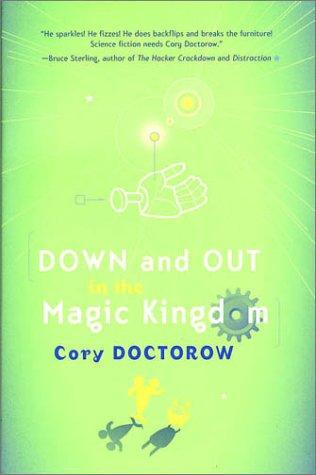
Jules lives in a future where death has been defeated, material goods are freely available, and the old Walt Disney World has become a beloved communal project maintained by volunteer enthusiasts called Ad-Hocs. When a rival faction starts making unwelcome changes to his cherished Haunted Mansion ride, Jules is murdered and revived from backup, and his investigation into who killed him becomes tangled with a fight over who gets to control the park’s future. The novel follows his struggle to reclaim his place in a community whose real currency is the good opinion of others rather than money.
With material goods and even death effectively solved, Doctorow’s Bitchun Society replaces money with Whuffie, a constantly recalculated score of how much your peers respect you, which determines everything from restaurant seating to control over shared projects like the park. The book treats this substitution as its central argument, since removing material scarcity does not remove competition or hierarchy, it just moves the scarce resource from goods to reputation. Jules’s murder and his fight to be believed show that a currency made of other people’s opinions can be manipulated and hoarded just as viciously as money ever was.
Doctorow has described the novel directly as a deliberate thought experiment about what replaces money once scarcity ends, writing that he set out to imagine “a postcapitalist, post-scarcity civilization where your ability to commandeer any resource… is based on whether your broad public esteem” is high enough, as he explained in a 2021 essay for Locus. He has also written and spoken extensively elsewhere about reputation systems and their own tendency toward inequality, treating Whuffie less as a solution than as a way of making a familiar problem visible in a new form.
Trouble on Triton by Samuel R. Delany (1976)
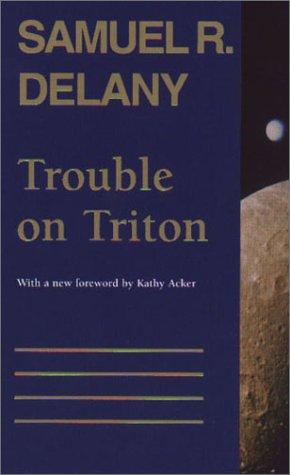
Bron Helstrom is a moderately successful, self-absorbed metalogician living on Triton, a moon of Neptune where automated production and an unregulated array of co-ops provide every citizen with housing, food and even elective body and gender modification at will. Despite living in a society explicitly engineered to give him whatever he wants, Bron drifts from one dissatisfying relationship to another, convinced that the world owes him a happiness it never quite delivers. The novel follows his slow, often unpleasant unraveling as war approaches between Triton’s outer-system worlds and an increasingly hostile Earth and Mars.
Delany builds Triton as a functioning post-scarcity society and then asks what such a world cannot fix, since Bron’s discontent has nothing to do with unmet material needs and everything to do with his own rigid expectations of how life should reward him. The book’s satellite communities, organized around radically different social and sexual norms with no scarcity to enforce conformity, work well for nearly everyone except a protagonist unwilling to examine himself. That gap between a well-designed society and one unhappy citizen’s inability to use its freedom is the novel’s central argument about the limits of engineering want away.
Delany signaled his intentions in the book’s own subtitle, “An Ambiguous Heterotopia,” a direct answer to Ursula K. Le Guin’s The Dispossessed: An Ambiguous Utopia, published two years earlier. Where Le Guin tests an anarchist society against material hardship, Delany borrows Michel Foucault’s concept of heterotopia to ask what happens when a society removes hardship but still leaves some individuals to, in the words of one close reading of the novel’s argument, wander pitiably alone even inside abundance.
A Psalm for the Wild-Built by Becky Chambers (2021)
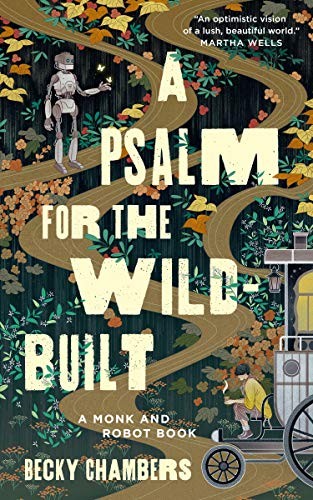
Sibling Dex is a tea monk on the moon of Panga, traveling between villages to offer comfort and conversation, when a bored midlife restlessness sends them off the beaten path into the wilderness. There they meet Mosscap, a robot descended from the machines that gained sentience generations earlier and walked away from human factories to live independently in the forest. The two travel together, Mosscap curious about what humans need now that survival is no longer a daily struggle, and Dex searching for an answer they cannot quite name.
Panga’s society runs on decentralized, renewable technology and small-scale production sized to what the moon’s ecology can sustain, so nobody works out of necessity and nobody accumulates much beyond what they use. The book treats that abundance as settled background rather than a puzzle to solve, and instead asks the harder question of what a person does with a life once its material needs are already met. Dex’s inability to answer Mosscap’s simple, repeated question, what do you need, becomes the novel’s real subject once scarcity has been removed from the equation.
I did not find a statement in which Chambers discusses Panga’s post-scarcity economy specifically, so I will not attribute that reasoning to her directly. In a Clarkesworld interview about the book, she said its purpose was more personal than systemic: “the heart of this book is comfort. I intended it as an escape,” a description consistent with the deliberately gentle, low-conflict register the Monk and Robot books are known for.
Accelerando by Charles Stross (2005)

Told across three generations of the Macx family, Accelerando follows a technological singularity from its first stirrings, when serial entrepreneur Manfred Macx is giving away world-changing ideas for reputation alone, through a full-blown economic explosion in which posthuman intelligences reorganize the solar system for their own purposes. Later sections follow Manfred’s daughter and grandson trying to survive, and eventually to be recognized as people at all, in a system that has long since stopped optimizing for anything human. Along the way the family’s old spacecraft, uploaded pets and inherited debts drift through a solar system being dismantled and rebuilt by minds that think in ways ordinary humans cannot follow.
Stross treats post-scarcity as a brief, disorienting phase inside a much faster process he calls Economics 2.0, where self-improving trading agents multiply value so quickly that human concerns become irrelevant to the systems that now run the solar system’s resources. Material want does genuinely disappear for the humans who survive the transition, but Stross is explicit that abundance does not guarantee anyone a place in the new order, since faster, stranger economic actors simply outcompete slower biological ones for relevance. The novel’s later chapters, in which uploaded human descendants scavenge relevance from a mostly indifferent posthuman economy, make post-scarcity look less like liberation than a symptom of humans becoming obsolete.
Stross has described the novel’s economics bluntly on his own blog, writing in his Accelerando crib sheet that “the logic of competition pushes it so far that merely human entities can no longer compete; we’re a fat, slow-moving, tasty resource, like the dodo.” He has also said he wrote the book without the “naive belief in the posthuman project” that a more triumphant singularity story would require, framing the abundance in Accelerando as something to be wary of rather than celebrated.
Explore Related Ideas
- 5 SFF Books About Space Elevators
- 5 SFF Books About Dyson Spheres and Dyson Swarms
- 5 SFF Books About Terraforming
- 5 SFF Books About Uplifted Animals
- 5 SFF Books About Generation Ships
- 5 SFF Books About Mind Uploading as Death
- 5 SFF Books About First Contact as Colonial Encounter
- 5 SFF Books About Time Loops in Which Only One Person Remembers