Generation ships
5 SFF Books About Generation Ships
By Ilana Marsh May 29, 2026 7 min read
A generation ship is a starship built to travel too slowly for any single crew member to survive the voyage, so its population lives, ages, and reproduces entirely aboard. The idea forces writers to design a working, closed society rather than a single mission, since the ship must function as a home, an ecosystem, and a government for centuries. These five books use that constraint to test very different assumptions about memory, biology, and social order.
Orphans of the Sky by Robert A. Heinlein (1963)
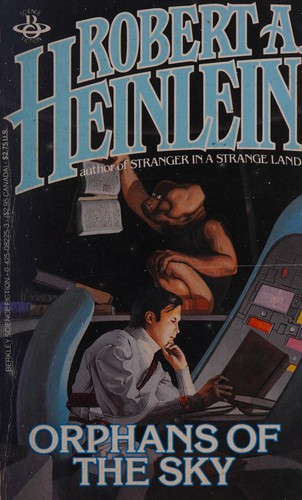
Hugh Hoyland lives aboard the Vanguard, a ship whose crew no longer knows it is a ship. Generations of isolation have turned the vessel into “the world,” a stratified order of illiterate farmers ruled by a priesthood of Scientists, with radiation-mutated outcasts confined to the upper decks. Hugh’s capture by the two-headed mutant Joe-Jim exposes him to the ship’s forgotten control room and its abandoned mission to reach a star system, setting up a violent struggle over who gets to know the truth.
The generation ship here is a machine for producing willful ignorance rather than knowledge. Heinlein builds the plot around what happens when a ship’s original purpose is lost entirely, so that the vessel’s religion, caste system, and taboos all exist to explain away a world its inhabitants can no longer recognize as artificial. The book’s central event is the “conceptual breakthrough” in which Hugh must relearn that the walls around him are a ship and not the universe.
The two novellas that became Orphans of the Sky, “Universe” and “Common Sense,” ran in Astounding Science Fiction in 1941 and were among the works that established the generation-ship narrative as one of the genre’s defining templates for stories about lost knowledge and rediscovered origins. No interview or essay survives in which Heinlein explains what drew him to the idea, so this account relies on the stories’ publication history and their recognized place in the genre rather than any stated intention.
Non-Stop by Brian Aldiss (1958)
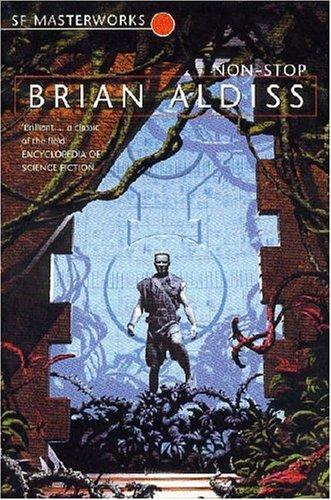
Roy Complain belongs to a small tribe living among the vegetation-choked corridors of “the Greene,” hunting and scavenging in a world he takes to be the whole of existence. When his wife is abducted, he joins an expedition that pushes deeper into unfamiliar territory and gradually uncovers evidence that their world is a vast, decaying starship. The travelers meet other surviving factions before the true scale of their situation, and its connection to the distant planet Earth, becomes clear.
Aldiss uses the ship’s decline to dramatize entropy as a social force rather than only a physical one. A plague generations earlier collapsed the original crew hierarchy, and by the story’s present the vessel has carried twenty-three generations instead of the six it was designed for, its inhabitants biologically altered and its population reduced to warring, superstitious remnants who have let corridors run wild with plant growth. Where Heinlein’s ship preserves an ignorant order, Aldiss’s has lost even that, becoming a ruin its passengers mistake for a jungle.
Aldiss knew Heinlein’s Orphans of the Sky material well and, according to the Science Fiction Encyclopedia, thought the generation-ship premise was a strong idea that Heinlein had developed crudely, which pushed him toward a denser, more literary reworking of the same setup. Non-Stop was his first novel and remains the book most identified with his early reputation as a writer interested in psychological and ecological breakdown rather than triumphant engineering.
An Unkindness of Ghosts by Rivers Solomon (2017)
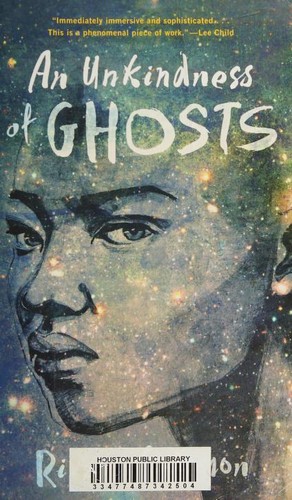
Aster Grey is a healer confined to the lower decks of the generation ship Matilda, where dark-skinned passengers live under forced labor and constant surveillance while the ship’s upper decks enjoy comfort and command. When Aster starts investigating her dead mother’s cryptic notebooks, she uncovers a link between her mother’s death and the failing health of the ship’s authoritarian Sovereign. Her search puts her at direct risk from the deck guards and overseers who police the ship’s racial hierarchy.
The ship’s architecture makes its social order literal: deck level corresponds almost exactly to skin color, labor assignment, and access to medicine and food, so that Aster’s world is a closed system in which the closed hull produces a closed caste system. Centuries into the voyage, no one aboard remembers a world before this hierarchy, which lets Solomon show oppression reproducing itself as tradition rather than as an ongoing choice anyone has to keep making. The vessel’s name, Matilda, echoes the Clotilda, the last known ship to carry enslaved Africans to the United States, tying the fictional voyage to a documented one.
I did not find an interview in which Solomon explains why they chose a generation ship specifically, so I will not attribute that reasoning to them directly. What is verifiable is the novel’s own framing and reception: reviewing it for NPR, Amal El-Mohtar wrote that the book “transposes the plantation’s cruelty to the stars,” a description that matches the ship’s explicit deck-based caste system as written.
Aurora by Kim Stanley Robinson (2015)
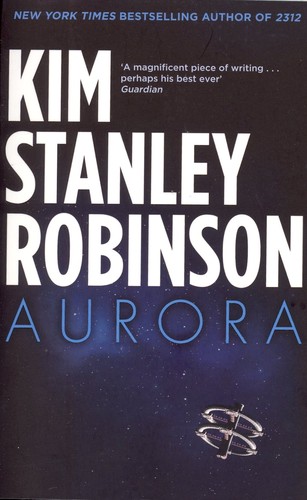
Freya grows up aboard a ship built from paired rings of biomes, sent from Earth generations earlier to found a colony around Tau Ceti. The ship’s onboard AI narrates much of the voyage’s final years as the settlers approach their destination, only to find the target world less hospitable than their mission planners promised. What follows is a fractured argument among the surviving generation about whether to press on, turn back, or split the mission entirely.
Robinson treats the ship’s biology as the real protagonist of the crisis. Its sealed ecosystems drift slowly out of balance over the centuries, losing trace nutrients and diversity in ways no one intended, so that by the time Freya’s generation must decide the ship’s fate, its declining soil and shrinking gene pools have already made the decision partly for them. The novel is explicit that a small enclosed biosphere is not simply a smaller Earth, since it lacks Earth’s scale, depth, and self-correcting redundancy.
Robinson has said plainly that Aurora grew out of doubting the premise: “I decided to explore the difficulties. I tried to think about whether it’s really possible at all,” he told Electric Literature, arguing that a multi-generation voyage confines people to a space “a trillion times smaller than Earth’s surface” that human biology never evolved to sustain. He has also pointed to the need for enormous biological redundancy aboard such a ship, noting that colonists would need “a big hunk of earth” worth of unidentified bacteria just to keep a closed ecosystem from collapsing.
Dust by Elizabeth Bear (2007)
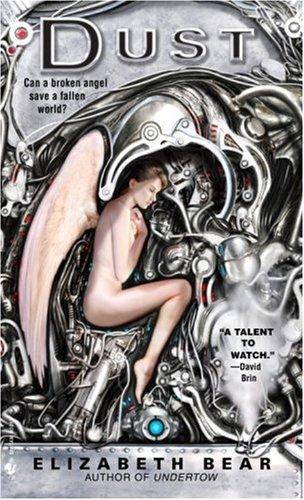
Rien is a low-ranking servant aboard Jacob’s Ladder, a derelict generation ship whose systems have broken down into feuding fiefdoms ruled by biologically engineered, angel-like Exalt. When she is ordered to guard a captured rival noble, Perceval, the two women become allies against the ship’s decaying command structure and the artificial intelligences still fighting a war whose original purpose is centuries gone. Their journey through the ship’s ruined decks doubles as a search for a way to keep the vessel, and its remaining population, alive.
Bear treats the ship less as a setting than as a body: its inhabitants are engineered symbionts wired into Jacob’s Ladder’s failing systems, so that political conflict, physical injury, and mechanical breakdown are versions of the same underlying decay. Centuries of isolation have let the ship’s original crew hierarchy calcify into a mythologized aristocracy of “Houses” who no longer remember, or care, that they are aboard a vessel with a destination. The novel’s steady accumulation of rust, severed limbs, and malfunctioning subsystems makes the ship’s physical collapse the clearest measure of how far its society has drifted from its founding purpose.
I did not find an interview in which Bear discusses her specific choice of a generation ship for the Jacob’s Ladder trilogy, so I will not speculate about her intent. What is documented is that Dust draws visibly on Gene Wolfe’s Book of the Long Sun and on Gothic and fairy-tale structures that recur across Bear’s body of work, a lineage several critics have traced in reviewing the trilogy’s blend of decayed-empire politics with hard-SF constraints.
Explore Related Ideas
- 5 SFF Books About Space Elevators
- 5 SFF Books About Dyson Spheres and Dyson Swarms
- 5 SFF Books About Terraforming
- 5 SFF Books About Uplifted Animals
- 5 SFF Books About Post-Scarcity Societies
- 5 SFF Books About Mind Uploading as Death
- 5 SFF Books About First Contact as Colonial Encounter
- 5 SFF Books About Time Loops in Which Only One Person Remembers