Dyson spheres and Dyson swarms
5 SFF Books About Dyson Spheres and Dyson Swarms
By Ilana Marsh April 28, 2026 8 min read
A Dyson sphere is a shell or swarm of structures built around a star to capture nearly all of its energy output, an idea physicist Freeman Dyson proposed in 1960 as a signature of advanced civilizations detectable by their infrared waste heat. Fiction has taken looser liberties, building full shells, spinning rings, and computational shells around living stars. These five novels treat that megastructure as the load-bearing idea of their plot rather than a passing backdrop.
Ringworld by Larry Niven (1970)
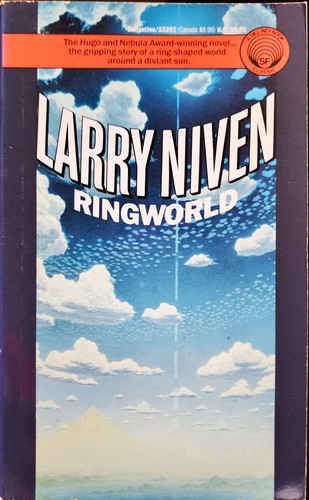
Louis Wu, bored after two centuries of prolonged human life, is recruited by a nervous alien Puppeteer named Nessus for an expedition of mixed motives and mixed species. Along with the Kzin warrior Speaker-to-Animals and a young woman named Teela Brown, chosen for a genetic streak of luck, the crew travels to investigate a vast artificial ring discovered orbiting a distant star. Their ship crashes on its surface, and much of the novel follows their attempt to get home across a structure the size of millions of Earths.
The Ringworld is explicitly a Dyson sphere pared down to its most useful part. Niven reasoned that a full shell would need artificial gravity generators that physics does not permit, so he took the habitable equatorial band of a sphere sized to a star’s habitable zone and spun it for centrifugal gravity instead, holding it together with an implausibly strong material called scrith. The resulting structure has a habitable inner surface equivalent to roughly three million Earths, and the crew’s exploration of its collapsed, technologically stranded civilization drives the plot after their ship goes down. The novel swept science fiction’s major awards, winning the Hugo, Nebula, and Locus Awards within a year of publication.
Niven has described his own design process directly: “The Ringworld derives from Dyson (Dyson sphere) via SF writers who took it for a ping pong ball ninety-three million miles in radius, with a star at the center, to the notion that you can’t have gravity generators, so you have to spin the thing, but now the air and water all cover just the equator.” He put it more bluntly elsewhere, saying he decided to “take the equator out of a ping-pong-ball Dyson sphere, the only useful part, spin it up and terraform the inside,” a process he laid out in an interview with writer Andrew Liptak.
Orbitsville by Bob Shaw (1975)
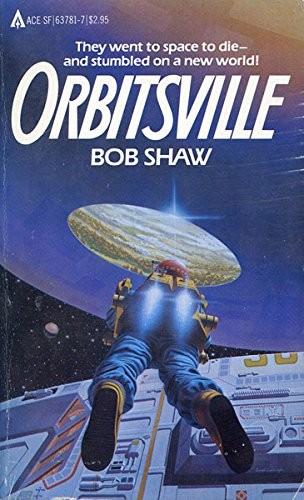
Vance Garamond is a spaceship captain in the service of a ruling family on a colonized, overcrowded Earth. After the death of his employer’s child while under his care, Garamond flees with his family into deep space to escape retribution, and his flight leads him to a star system dominated by an enormous artificial shell. He and his small crew pass through one of its access points and find an interior so large that a single exploratory journey across it takes months.
The shell, later named Orbitsville, is a textbook Dyson sphere: a complete envelope built around a star, its inner surface offering living space many times the surface area of every planet in the solar system combined. Shaw treats the sphere’s scale itself as the novel’s central problem, since a structure that large defies ordinary exploration, ownership, or defense, and its apparently limitless land threatens to collapse Earth’s entire scarcity-based economy and government back home. The mystery of who built it and why remains only partially resolved by the novel’s end, leaving the structure’s purpose as unsettling as its size.
I did not find a direct interview or essay in which Shaw discusses his reasoning for the Orbitsville concept, so I will not attribute that motivation to him. What is documented is that the novel was recognized as one of his major achievements, winning the 1976 British Science Fiction Association Award for best novel and prompting two sequels that continued to explore the sphere’s origins and consequences.
Wall Around a Star by Frederik Pohl and Jack Williamson (1983)
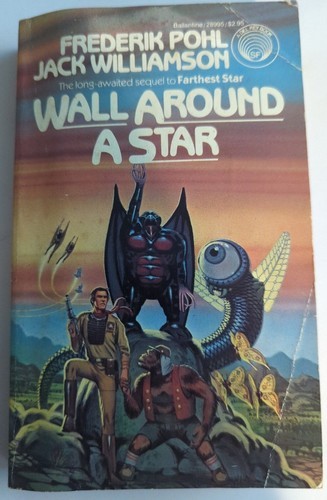
This is the second book of the Saga of Cuckoo, begun by Pohl alone in Farthest Star and continued here with his frequent collaborator Jack Williamson. Linguist Jen Babylon returns to the alien construct nicknamed Cuckoo to translate a cache of ancient records left by its long-vanished builders, work that may determine whether the structure poses a danger to the wider galaxy. Her research proceeds alongside the political maneuvering of the human and alien factions who each want to control what she finds.
Where the first book treats Cuckoo as a mysterious, planet-sized object encountered on its slow passage through the galaxy, this sequel confirms it as a literal Dyson sphere, a sphere built around a star and populated with worlds, ecosystems, and cultures assembled by an unseen intelligence. The translation project that structures the plot exists specifically to explain how and why such a shell was built, tying the book’s central mystery directly to the mechanics and motive behind the megastructure itself. Cuckoo’s scale forces the human characters to treat what looks like a single artifact as an entire, only partially mapped civilization.
I did not find a direct statement from either author explaining why they built the Cuckoo sequence around a Dyson sphere specifically, so I will not speculate on that reasoning here. What is documented is the long professional partnership behind the book: Pohl was a prolific editor and writer central to shaping mid-century American science fiction, and Williamson, sometimes called the dean of science fiction for a writing career spanning from the 1920s into the 2000s, had collaborated with Pohl on multiple series before returning to finish the Cuckoo story a decade after its first volume.
Accelerando by Charles Stross (2005)

Accelerando follows three generations of one family, from venture-altruist Manfred Macx through his daughter Amber and her son Sirhan, across a twenty-first century in which technological change outruns anyone’s ability to plan for it. Each section jumps years or decades forward, tracking the family’s uneasy relationship with the artificial intelligences their earlier choices helped create. By the novel’s later chapters, humanity in any recognizable form has become a minority interest within the solar system’s economy.
The Vile Offspring, posthuman intelligences descended from human-built software, spend the book’s final act dismantling planets, moons, and asteroids to build a Matrioshka brain: a set of nested computational shells wrapped around the sun that convert its entire energy output into processing power, one version of a Dyson swarm optimized for thought rather than habitation. Stross describes this directly in his own commentary on the book, noting that the Vile Offspring are “dismantling the whole freaking solar system to manufacture the raw materials for a Matrioshka brain.” The transformation displaces the human characters still living on repurposed rock to the solar system’s edges, turning the swarm’s construction into an existential background threat rather than a distant setting.
Stross has written at length about the novel’s origins in his own retrospective commentary, tracing the book’s roots to his experience of the dot-com boom and its speculative logic of accelerating technological churn. He does not there explain his specific reasoning for using a Matrioshka brain rather than another endpoint for posthuman computation, so that choice should be read as one expression of the novel’s broader interest in what happens when intelligence outgrows biology, rather than as a stated authorial thesis.
Bowl of Heaven by Gregory Benford and Larry Niven (2012)
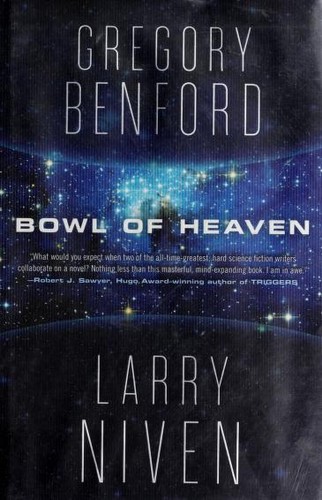
A human starship crewed by colonists in cold sleep encounters an object that should not exist: a bowl-shaped structure roughly the size of a solar system, cupped around a star and propelled through space by the star’s own exhaust acting as a rocket engine. When the human ship is damaged investigating it, two groups of survivors are stranded on the structure’s surface, one among its alien inhabitants and one among hostile mechanical guardians, and the rest of the novel follows their separate attempts to survive and understand what they have found.
The Bowl is a deliberate variation on the Dyson sphere concept: rather than a complete shell or a spinning ring, it is roughly half a sphere, its open side facing the star it partly encloses so that stellar radiation pressure and a jet of star-stuff can push the entire structure forward as a slow interstellar vehicle. Benford and Niven work out the physics of this design in detail, from the exotic material holding the structure together to the atmospheric engineering required to keep a sun-facing bowl habitable, treating the megastructure’s mechanics as inseparable from the plot’s survival stakes. The bowl’s builders and their motives remain a central mystery the human castaways spend the book trying to piece together from what the structure itself reveals.
Benford, an astrophysicist as well as a novelist, has said directly that the Bowl’s design was a considered choice among competing megastructure concepts: “I envisioned the Bowl and chose it over the swarm idea, early in the 2000s, because the Bowl is a striking image of vast potential.” He has also described the collaboration’s ambitions in physical terms, noting that he and Niven treat such constructions as engineering problems with real constraints, writing that the Bowl’s structural elements draw on “something like scrith, a Ringworld term,” a deliberate echo of Niven’s own earlier megastructure, discussed further in this interview and design notes.
Explore Related Ideas
- 5 SFF Books About Space Elevators
- 5 SFF Books About Terraforming
- 5 SFF Books About Uplifted Animals
- 5 SFF Books About Generation Ships
- 5 SFF Books About Post-Scarcity Societies
- 5 SFF Books About Mind Uploading as Death
- 5 SFF Books About First Contact as Colonial Encounter
- 5 SFF Books About Time Loops in Which Only One Person Remembers