Sentient trees
5 SFF Books About Sentient Trees
By Ilana Marsh June 27, 2026 8 min read
A sentient tree, for this list, is one that thinks, remembers, or acts with purpose, whether alone or as part of a larger woodland mind. That rules out forests used only as spooky backdrops. Real botany already shows trees sharing nutrients and warning signals through root and fungal networks; these five books push that fact toward full personhood, memory, and intention.
Mythago Wood by Robert Holdstock (1984)
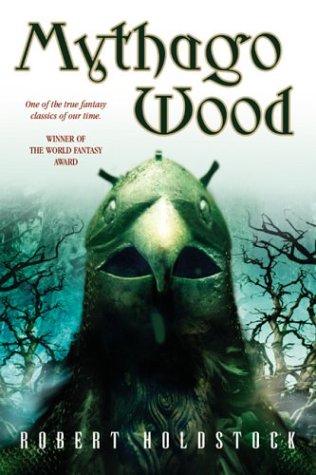
Ryhope Wood is a small patch of ancient British forest that turns out to be far larger on the inside than its edges suggest, generating living embodiments of half-remembered myths, the mythagoes of the title. Steven Huxley returns to his family’s estate after the war to find his brother obsessed with the wood and its power to pull psychological archetypes out of the human unconscious and give them flesh. What follows is as much an exploration of inherited trauma as it is a journey into the trees.
The wood itself is the book’s central intelligence: Holdstock describes it as a place where “a sentience abides, feeding on human dreams, on the collective unconscious, on lost memory: bringing it all alive,” an active, shaping force with its own hidden logic rather than passive scenery. Its size expands to match whatever story is being told inside it, and the deeper characters travel, the older and stranger the layers of myth they encounter become. The wood’s persistence across the linked Ryhope Wood novels confirms that Holdstock meant it as a permanent character rather than a one-off setting.
Holdstock said the novel grew out of his own dreams and out of the eerie tales his grandfather told him as a child, which gave him the whole shape of the story almost as soon as he had drafted its origin as a short piece. He did not leave a detailed account of why he made the wood itself a conscious entity rather than simply a haunted location, so that particular choice is best read through the finished books rather than through any single stated intention.
Uprooted by Naomi Novik (2015)
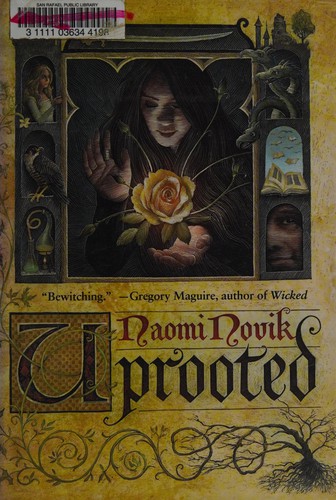
Agnieszka lives in a valley bordered by the Wood, a forest that corrupts anyone who wanders too far into it and periodically claims a young villager to serve a wizard known as the Dragon in exchange for his protection. When the Dragon chooses Agnieszka instead of her more obviously gifted friend, she discovers her own untrained magical talent while learning that the Wood’s threat runs deeper and older than anyone in the valley understood. Her fight against it becomes a fight to understand what the forest actually wants.
The Wood in Novik’s telling acts with deliberate malice, planting corrupted seeds in human bodies, twisting captured people into monstrous servants, and extending its reach a little further every generation through slow, patient encroachment. Its intelligence is confirmed late in the book, when its origin is revealed as a once-human consciousness transformed and consumed by grief and rage, which is why it behaves less like weather and more like a mind pursuing a purpose. That backstory turns the forest from an obstacle into the novel’s real antagonist.
Novik has said she drew on the Polish fairy tales her mother read to her as a child and set the book in a version of Poland that existed in her head when she was five years old, a place she called “very real to me as a child” even though it never existed on a map. She has not given a specific account of what shaped the Wood’s malevolence in particular, so that detail is best attributed to the fairy-tale tradition she describes drawing on generally rather than to any single named source.
Semiosis by Sue Burke (2018)
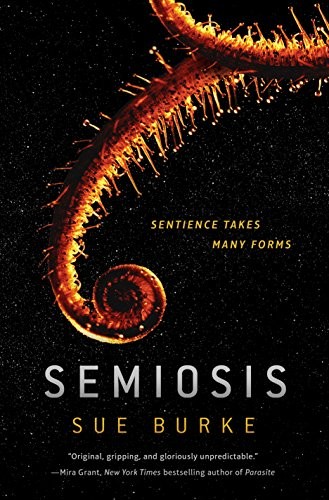
Human colonists flee a ruined Earth in the 2060s to settle the planet Pax, where they find an abandoned city built by an earlier, vanished civilization and a world of plant life far more assertive than anything from home. Told across seven generations of the same family line, the novel follows the colonists as they slowly realize that a bamboo-like plant living in and around the city, whom they name Stevland, is intelligent and has its own agenda for the humans living among it. Their survival ends up depending on learning to treat Stevland as a partner rather than a resource.
Stevland communicates through chemical signals, engineered fruit, and eventually a constructed alphabet of colored leaves, and it has spent centuries manipulating the local ecosystem, including wiping out a rival stand of trees, long before humans arrived to complicate its plans. Burke gives it clear strategic intelligence: it withholds information, forms alliances, and defends the colony against both native threats and a nomadic rival civilization, acting throughout as a character with its own goals rather than a passive resource to be farmed. Its centrality to the plot only grows across the linked sequel novel, confirming that Stevland was conceived as the story’s true protagonist.
Burke has said the character began with an observation from her own home: “a couple of my houseplants attacked other houseplants,” which sent her into research on real plant aggression and chemical signaling. She found that “plants are active, aggressive, and fight to the death for sunlight,” and used documented behavior like strangler figs and thorned climbers to build Stevland’s tactics on real botanical precedent rather than invented magic.
The Two Towers by J.R.R. Tolkien (1954)
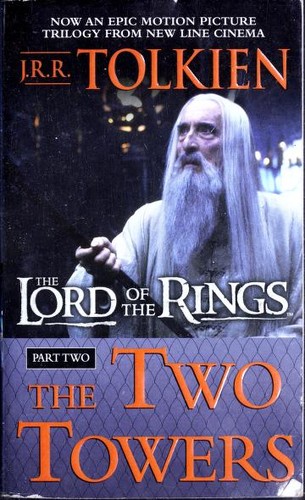
The second volume of The Lord of the Rings follows the broken Fellowship in three directions at once, and one of those threads leads Merry and Pippin into Fangorn Forest, where they meet Treebeard, oldest of the Ents. Treebeard convenes a slow council of his fellow tree-shepherds to decide how to respond to Saruman’s wholesale destruction of the forest around Isengard, and their eventual decision to march on the wizard’s fortress becomes one of the volume’s central turning points. The hobbits’ brief captivity among the Ents doubles as an education in a form of intelligence entirely unlike their own.
Ents are explicitly trees that have become fully awake and mobile, shepherds set over the forests in a much earlier age, and their pace of thought and speech is as slow and deliberate as tree growth itself, with Entish described as a language too long for anything but Ents to use. Their anger, once roused by Saruman’s engines and fires, drives the actual destruction of Isengard’s wall and machinery in one of the trilogy’s decisive military actions. The species also carries a quieter tragedy in the loss of the Entwives, giving the Ents a history and a grief of their own rather than leaving them as background flavor.
Tolkien said directly that the Ents grew out of his schoolboy irritation with Shakespeare, writing that he felt “bitter disappointment and disgust from schooldays with the shabby use made in Shakespeare of the coming of ‘Great Birnam wood to high Dunsinane hill’” and that he “longed to devise a setting in which the trees might really march to war,” a statement recorded in his letter to W.H. Auden discussing the book’s origins. Scholars have also connected the Ents’ fury at Saruman’s deforestation to Tolkien’s lifelong unease about industrial destruction of the English countryside, though that broader concern is inference from his letters and essays rather than a single direct statement about the Ents specifically.
Midworld by Alan Dean Foster (1975)
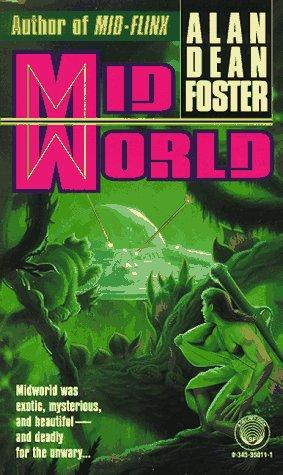
Midworld is a planet entirely covered by rain forest nearly a kilometer tall, home to a human society descended from a lost colony ship that has lived there in careful balance with the jungle for centuries. Born, a skilled hunter of that society, lives bonded to an intelligent, plant-based creature called a furcot and communicates with the surrounding vegetation through an empathic sense his people call emfoling. When representatives of an exploitative offworld corporation crash nearby, hunting a life-extending drug found in the forest’s giant trees, Born is drawn into a conflict between his world’s living balance and outside extraction.
The forest on Midworld carries far more weight than lush background: the novel treats individual trees, the furcots, and the wider jungle as nodes in a single distributed awareness that the native humans can sense and negotiate with directly, asking permission before harvesting anything they need. The They-Who-Keep trees that receive the dead deepen this network further, and by the novel’s end a character’s mind is absorbed into “a developing planet-wide network of consciousness” that includes the trees and the furcots together. That ending confirms the forest’s sentience as a structural fact of the world rather than a mystical flourish.
Foster has not given, in any available interview, a direct account of what specifically inspired Midworld’s sentient jungle, so that origin is best left unattributed rather than guessed at. What is documented is his long career of prolific tie-in and original science fiction beginning in the early 1970s, and Midworld’s own afterlife as a book some readers and critics have noted as a likely influence on the forest-planet ecology of James Cameron’s Avatar, decades after its original publication.
Explore Related Ideas
- 5 SFF Books About Space Elevators
- 5 SFF Books About Terraforming
- 5 SFF Books About Uplifted Animals
- 5 SFF Books About Generation Ships
- 5 SFF Books About Post-Scarcity Societies
- 5 SFF Books About Mind Uploading as Death
- 5 SFF Books About First Contact as Colonial Encounter
- 5 SFF Books About Time Loops in Which Only One Person Remembers